
The Cover Note
How Irish Brokerages Are Using AI to Cut the Admin Out of Renewals
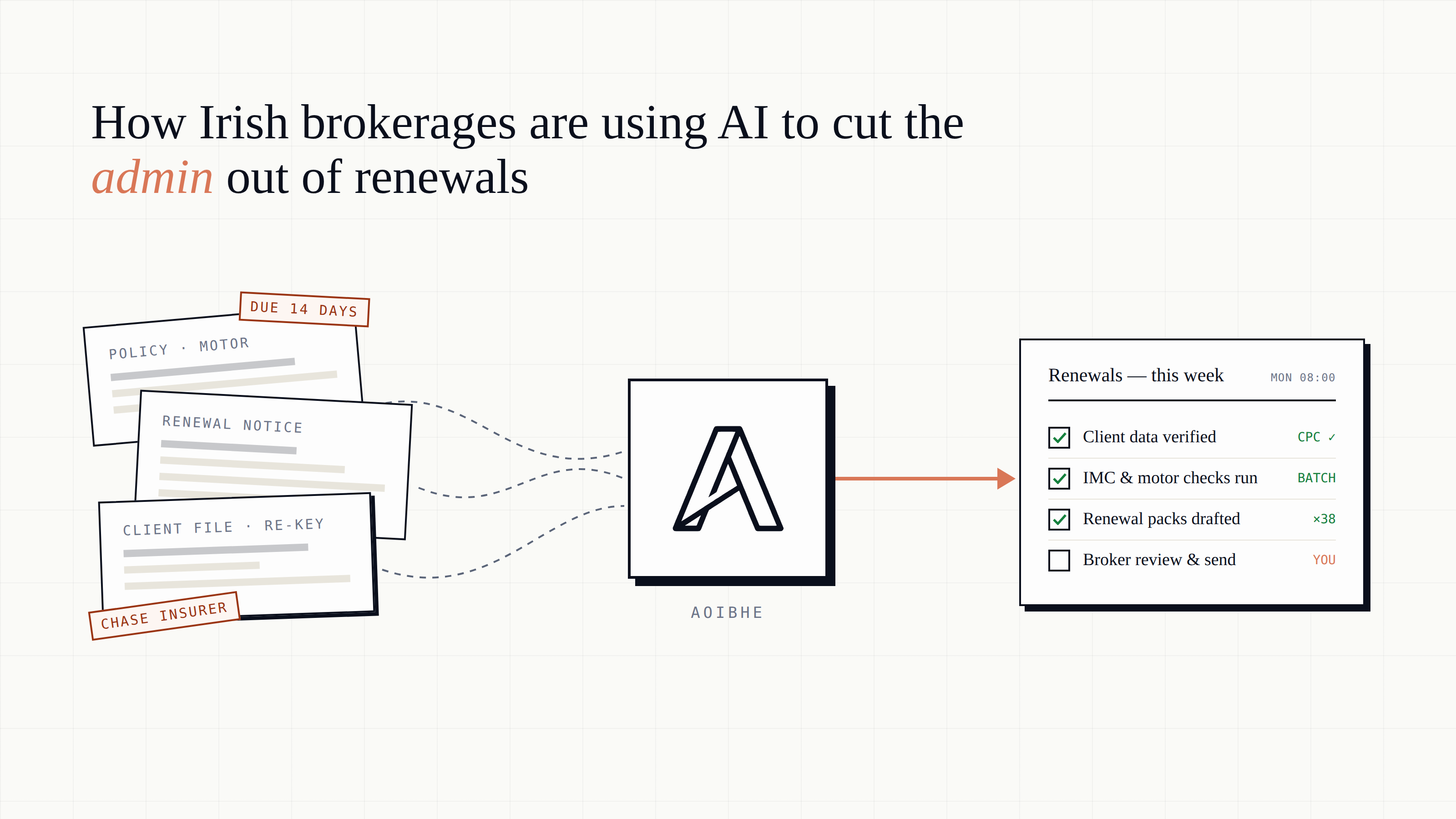
The Typical Brokerage Tech Stack Is Not Really a Stack
Most Irish brokerages are running on a combination of a broker management system, a few insurer portals, a shared drive, and email. That is not a stack. That is a collection of tools that do not talk to each other, held together by staff who know where everything lives.
Why Manual Processes Break Down at Renewal Time
Renewal season compresses the problem. A broker working a motor book with several hundred renewals in a 60-day window is moving fast. Data gets copied between systems by hand. Mistakes get made. Policies go out with the wrong vehicle reg, the wrong address, or a sum insured that has not been touched in three years.
The issue is not that brokers are careless. It is that the process is designed to produce errors. Manual re-keying between systems is error-prone by nature, and the volume at renewal makes it worse.
Data Quality Is a Compliance Issue, Not Just an Admin One
What the Consumer Protection Code Expects
The Consumer Protection Code requires brokers to hold accurate, up-to-date information on their clients. That obligation does not pause at renewal. If a client's circumstances have changed and the policy does not reflect that, the broker carries risk, not just the insurer.
The Central Bank of Ireland expects brokerages to have systems and controls in place that support compliant outcomes. Relying on a member of staff to manually check whether an address has changed before issuing a renewal letter is not a control. It is a hope.
Where Dirty Data Creates Real Risk
A home policy issued to an address that no longer matches the property on record. A motor policy where the named driver has changed but the system was not updated. A commercial client whose turnover figure is three years out of date. Each of these is a potential claim dispute waiting to happen, and each one traces back to data that nobody caught.
What Automated Data Cleansing Actually Does
Automated data cleansing tools scan records against authoritative sources and flag inconsistencies before they become problems. That means checking addresses against Eircode data, identifying duplicate records, and surfacing fields that have not been updated within a defined period.
The point is not to replace the broker's judgement. It is to make sure the broker is looking at clean information when they make a decision, rather than discovering mid-renewal that the client moved 18 months ago.
IMC Checks, Motor Checks and Scheme Memberships: Why Brokers Are Still Doing These by Hand
IMC checks, motor checks and scheme membership are a routine part of a broker's workflow, particularly on motor books. The process is straightforward in principle. In practice, many brokers are still logging into separate systems, running checks one at a time, and recording the results manually.
For a small book, that is manageable. For a broker handling hundreds of motor renewals, it adds up quickly. An hour a day across a six-week renewal window is a significant cost, and that is before you account for the times a check gets missed because someone was pulled onto something else.
AI tools that integrate with these check processes can batch the work, flag exceptions, and log results directly into the broker management system. The broker still reviews the output. They are just not doing the retrieval work by hand.
Where AI Fits Into a Brokerage Workflow Today
The most practical applications of AI in Irish brokerages right now are not the headline-grabbing ones. They are the unglamorous tasks that eat time: chasing outstanding information before renewal, sorting incoming documents, cross-referencing client records, and drafting renewal letters from a template.
An AI teammate like Aoibhe sits inside the workflow and handles the retrieval and preparation work, so the broker can focus on the conversations and decisions that need a person. That is not a future-state description. That is how it works today for brokerages already using it.
What to Look for When Evaluating Any New Tool
Integration with your existing systems. A tool that requires you to export data, run it through a separate system, and import it back is not saving you time. It is moving the manual work around.
Audit trail. For compliance purposes, you need to be able to show what was checked, when, and by whom. Any tool you bring in should produce a clear record.
Data residency. Know where client data is being processed and stored. This matters for GDPR compliance and for your own PI cover.
Realistic implementation time. A tool that takes six months to configure is not solving your next renewal season. Ask what day-one usefulness looks like.
The Direction of Travel for Brokerage Tech in Ireland and the UK
The brokerages pulling ahead are not necessarily the ones with the biggest technology budgets. They are the ones that have identified where their admin load is heaviest and found tools that address those specific points.
The direction is towards brokerages where the administrative layer is largely automated, and the broker's time is concentrated on advice, relationships, and the complex cases that genuinely need their expertise. That shift is already happening. The question for most brokerage owners is how quickly they want to move.